Sales Promotion Strategies: Complete Guide
In today’s rapidly shifting market, you face unprecedented challenges that demand innovative methods to accelerate revenue growth. The traditional sales approaches that worked decades ago are no longer sufficient to meet the expectations of modern consumers, who are more informed, more demanding, and have countless alternatives at their fingertips.
Digital transformations have reshaped how customers research, evaluate, and purchase products or services. You’re no longer competing only with local businesses but also with global companies that can reach your customers through multiple digital channels. These shifts have made Sales promotion not merely an option, but a survival strategy.
Market research shows that companies adopting comprehensive Sales promotion strategies see 20–30% revenue growth compared to those relying exclusively on traditional methods. The speed at which customer preferences change today means you need dynamic, responsive approaches that can quickly adapt to market conditions.
Your customers now expect personalized experiences, instant responses, and seamless interactions across all touchpoints. Technological performance has raised the bar significantly, making it essential to leverage advanced tools and techniques to meet these demands effectively.
Understanding the Fundamentals and Core Concepts of Sales Promotion
Sales promotion is a strategic approach that goes beyond conventional sales tactics. At its core, it’s about creating structured processes and executing targeted activities designed to accelerate your sales cycle while maximizing conversion rates and customer value.
Unlike traditional methods that often rely on broad, generic offers and promotional messaging, Sales promotion focuses on specific, measurable actions that directly influence purchase decisions. In simple terms, you’re building a framework that turns prospects into customers more effectively and efficiently.
The fundamental difference between Sales promotion and traditional promotion lies in its strategic nature. While promotion often emphasizes short-term sales boosts through discounts or specials, Sales promotion embraces a holistic approach that includes customer-relationship management, data-driven decision-making, and long-term value creation.
A typical Sales promotion cycle includes several key stages: lead generation, needs assessment, solution presentation, objection handling, closing techniques, and post-sale relationship building. Each stage requires dedicated tools, techniques, and metrics to ensure optimal performance.
Understanding the segmentation of your target audience is critical to this process. Different customer segments respond to different activation strategies, and it’s essential to tailor your approach accordingly. For example, B2B customers usually require longer nurturing cycles and more detailed information, while B2C buyers may respond better to emotional triggers and instant-reward offers.
Traditional Sales Promotion Methods and Their Effectiveness
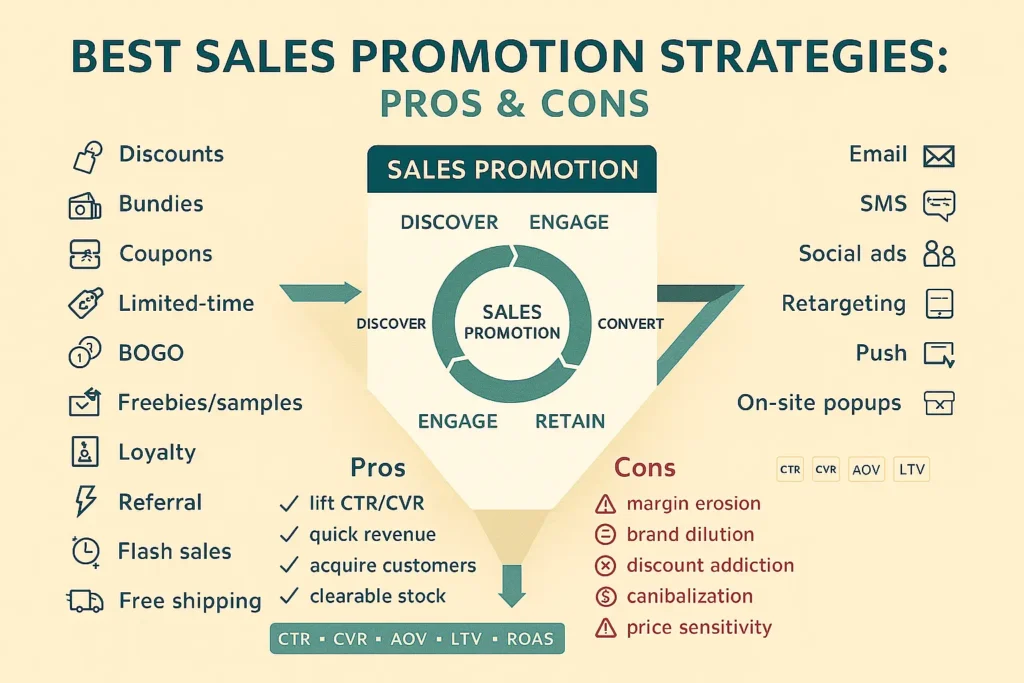
Despite the digital revolution, traditional Sales promotion methods still play a valuable role in your overall strategy. Direct discounts and promotional offers remain among the strongest tools for triggering immediate sales—especially when used strategically, not as desperate attempts to move inventory.
Loyalty programs and points-based reward systems have proven their worth over decades of implementation. When carefully designed, they create emotional bonds with customers that go beyond transactional relationships. The key is to make rewards meaningful and attainable while encouraging higher purchase frequency and larger order values.
Contests and incentive-based promotions leverage human psychology around competition and reward. You can deploy these effectively across different customer segments—from consumer sweepstakes to B2B productivity challenges that simultaneously engage your sales team and channel partners.
Free samples and promotional gifts serve two purposes: reducing purchase risk for customers and allowing them to experience your product quality firsthand. This approach is particularly effective for products where quality, taste, or functionality can be demonstrated through direct trial.
Trade shows and commercial events provide face-to-face engagement opportunities that are hard to replace. In an increasingly digital world, these personal connections become even more valuable—allowing you to build trust, showcase complex products, and gather immediate feedback from prospects.
The effectiveness of traditional methods often depends on timing, execution quality, and integration with your broader marketing strategy. When used as part of a holistic sales-activation approach rather than isolated tactics, these methods can deliver exceptional results.
Modern Digital Sales Promotion Techniques
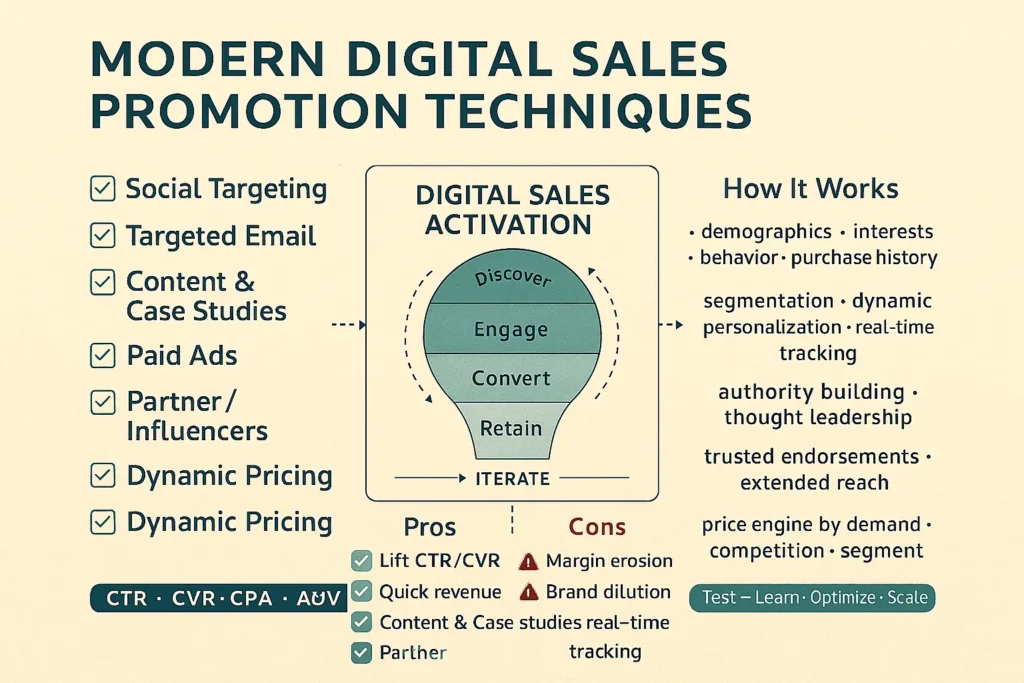
Digital sales activation has revolutionized how you reach, engage, and convert prospects. Social-media marketing enables precise targeting based on demographics, interests, behaviors, and even purchase history—allowing you to deliver highly relevant messages to qualified audiences.
Targeted email campaigns remain one of the highest-ROI digital channels when executed properly. You can segment your audience using multiple criteria, personalize content dynamically, and track engagement metrics in real time to continuously optimize performance.
Content marketing and success stories build trust and credibility while educating prospects about your solutions. By sharing valuable insights, case studies, and thought-leadership content, you position yourself as an expert while nurturing prospects along their buying journey.
Paid advertising with intelligent targeting—across platforms like Google Ads, Facebook, LinkedIn, and industry-specific channels—lets you reach prospects exactly when they’re searching for solutions like yours. The key is crafting compelling ad copy and high-converting landing pages that turn visitors into leads.
Partner marketing and influencer collaborations expand your reach via trusted third-party endorsements. When influencers or partners recommend your products to their audiences, you benefit from their credibility and established relationships.
Technology-powered dynamic pricing strategies enable you to optimize prices based on demand, competition, customer segments, and other factors. This approach maximizes revenue while keeping you competitive in your market.
Advanced Technological Tools for Sales Promotion
Customer Relationship Management (CRM) systems form the backbone of modern sales-activation strategies. These platforms centralize customer data, track interactions, manage leads, and deliver insights that enable personalized engagement at scale. You can automate follow-up sequences, score leads based on their behavior, and ensure no opportunities slip through the cracks.
Analytics and AI tools help you understand customer-behavior patterns, predict purchase likelihood, and identify the most effective sales strategies. Machine-learning algorithms can analyze massive data sets to uncover insights that would be impossible to detect manually.
E-commerce platforms and optimization tools let you deliver seamless online purchasing experiences. You can implement features such as abandoned-cart recovery, personalized product recommendations, cross-sell alerts, and streamlined checkout flows that reduce friction and increase conversion rates.
Sales and marketing automation systems handle repetitive tasks while ensuring consistent, timely communication with prospects and customers. You can set up sophisticated workflows that nurture leads automatically, deliver relevant content based on behavior, and alert your sales team when prospects are ready to buy.
Mobile apps for sales teams provide instant access to customer information, product catalogs, pricing tools, and communication capabilities. Sales reps can access everything they need while in the field, improving responsiveness and professionalism.
Virtual and augmented reality technologies deliver immersive product experiences and demos that were previously impossible. These tools are especially valuable for complex or high-ticket products where visualization and understanding are critical to purchase decisions.
Positive Advantages and Benefits of Sales Promotion
Increased revenue and profitability are the most immediate, obvious benefits of effective sales activation. When you systematically optimize sales processes, target the right customers with relevant messaging, and remove inefficiencies, revenue growth naturally follows.
Customer-base expansion occurs as you attract new market segments and convert prospects who previously weren’t ready to buy. Activation strategies create multiple touchpoints and engagement opportunities that reach different types of customers at different stages of their buying journey.
Brand awareness improves organically as activation efforts increase your market presence. Recognition and reputation in your field grow as a result of consistent, professional engagement—paired with valuable content and positive customer experiences.
Building a valuable customer database delivers long-term strategic advantages. Every interaction generates data about customer preferences, behaviors, and needs. This information becomes increasingly valuable for future marketing efforts, product development, and strategic planning.
Accelerated sales cycles reduce the time between first contact and final purchase. By implementing systematic follow-ups, proactively delivering relevant information, and removing purchase barriers, you help customers make decisions faster.
Enhanced competitive positioning stems from superior customer engagement and a more effective market presence. When your sales-activation efforts consistently outperform competitors, you gain market share and establish a stronger foothold.
Improved sales-team morale and performance happen when your team has better tools, clearer processes, and more success. High-performing activation systems provide the support and structure that enable individual sales reps to achieve better results with less stress.
Potential Challenges and Drawbacks of Sales Promotion
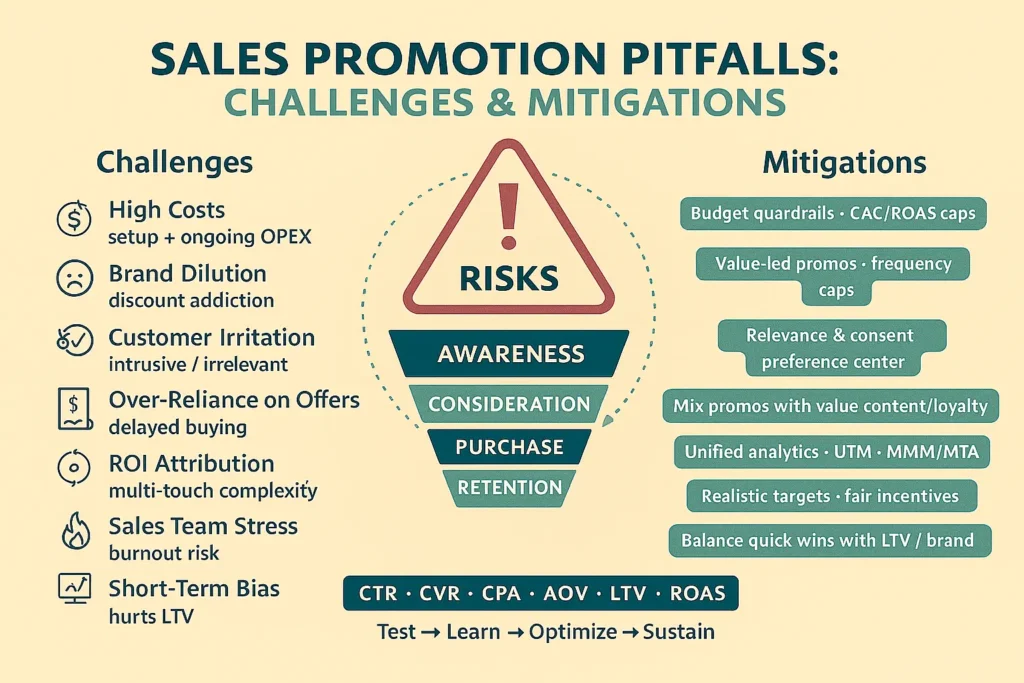
High costs and required investments can be significant—especially when implementing comprehensive technology solutions or launching major marketing campaigns. You need to budget carefully for both the initial setup and ongoing operating expenses to ensure a sustainable ROI.
There’s a risk of brand-value dilution when activation efforts are executed poorly or too aggressively. Over-promotion can train customers to expect constant discounts, which may erode brand perception and compress profit margins.
Customer irritation from excessive promotion is a major risk in today’s over-communicated marketplace. When your activation efforts become intrusive or irrelevant, you risk damaging relationships and pushing customers toward competitors.
Over-reliance on offers can develop when promotional activities become too frequent or predictable. This creates a cycle in which customers delay purchases until specials appear, reducing your pricing power and margins.
Difficulty measuring ROI stems from the complex, multi-touch nature of modern sales activation. Attribution becomes challenging when customers interact with multiple channels and touchpoints before making purchase decisions.
Sales-team pressure and stress can increase when activation strategies focus too heavily on immediate results without considering sustainable performance. Unrealistic expectations or poorly designed incentive systems can lead to burnout and turnover.
Tension between short-term results and long-term sustainability arises when activation strategies prioritize instant wins over relationship-building. While quick wins matter, you must balance them with long-term customer-value creation.
Successful Implementation Strategies for Sales Promotion
Developing a comprehensive, flexible sales-activation plan requires thorough market research, clear goal-setting, and a methodical design approach. Your plan should include specific objectives, a defined target audience, chosen methods, a timeline, budget allocation, and success indicators.
Precisely identifying the target audience goes beyond simple demographics to include behavior patterns, pain points, purchase triggers, and communication preferences. The more accurately you know your ideal customers, the more effectively you can design activation strategies that resonate with them.
Mapping methods to each stage of the sales cycle ensures optimal resource use and a smooth customer experience. Early-stage prospects may respond best to educational content and gentle nurturing, while late-stage buyers may need persuasive offers and streamlined purchasing processes.
Training sales and marketing teams ensures consistent execution and professional representation. Your team members need to understand not only the tactical aspects of activation strategies but also the customer psychology and strategic objectives behind them.
Budgeting and resource allocation require a realistic assessment of available funds, time, and human resources. Allocate resources according to the expected return on investment, while maintaining the flexibility to adjust based on performance data.
Cross-department coordination ensures sales-activation efforts align with broader business goals and avoid creating conflicts or confusion. Marketing, sales, customer service, and operations teams should work together seamlessly.
Keep reading and uncover secrets that can change the way you work. What are the types of advertising campaigns and how do you manage them?
Performance Measurement and Key Success Indicators
Key performance indicators (KPIs) provide quantitative measures of your sales-activation effectiveness. Core metrics include conversion rates at each funnel stage, average deal size, sales-cycle length, and overall revenue growth.
The lead-to-customer conversion rate shows how effectively your activation strategies move prospects through the sales process. This metric helps you identify bottlenecks and improvement opportunities within your funnel.
Average deal value and growth rate indicate whether your strategies are encouraging customers to purchase higher-value solutions or additional products and services.
Customer acquisition cost (CAC) measures the total investment required to acquire each new customer. This should be balanced against customer lifetime value (CLV) to ensure profitable growth.
Customer retention rate and satisfaction scores reflect the long-term effectiveness of activation strategies. High retention suggests your efforts are creating real value rather than merely pushing one-off transactions.
Return on investment (ROI) for campaigns is the ultimate measure of financial effectiveness. Track ROI for individual campaigns, channels, and your overall activation programs to optimize resource allocation.
Modern performance-measurement tools and software provide real-time dashboards, automated reporting, and advanced analytics. These tools help you spot trends, forecast outcomes, and make data-driven optimization decisions.
Keep reading and uncover secrets that can change the way you work. The best strategies to increase sales and how to apply them?
Future Trends in Sales Promotion
Artificial intelligence and machine learning are revolutionizing sales activation by enabling predictive analytics, automated personalization, and intelligent lead scoring. These technologies will increasingly handle routine tasks while delivering insights that improve human decision-making.
Personalization of individual customer experiences will grow more sophisticated as data-collection and analysis capabilities improve. You’ll be able to create unique experiences for each customer based on their specific preferences, history, and anticipated needs.
Omnichannel integration ensures consistent experiences across all customer touchpoints—from social media and websites to phone calls and in-person interactions. Customers expect seamless transitions between channels without having to repeat information or restart processes.
Big-data–driven decision-making will expand as storage costs drop and analytics tools grow more powerful. You’ll be able to incorporate external data sources, market trends, and predictive models into your sales-activation strategies.
Sustainability and social responsibility are becoming more important in sales, especially to younger demographics. Your activation strategies may need to incorporate messages about environmental and social impact to stay relevant.
Ongoing technological advances will continue to create new opportunities and challenges. Emerging technologies like blockchain, the Internet of Things (IoT), and advanced analytics will open new possibilities for customer engagement and sales optimization.
Keep reading and uncover secrets that can change the way you work. What is Ads Manager and how to use it?
Core Insights: Maximizing the Benefits of Sales Promotion
Achieving the right balance between advantages and drawbacks requires a well-crafted strategy that maximizes benefits while minimizing risks. You should regularly evaluate your activation efforts to ensure they’re creating sustainable value, not just short-term gains at the expense of long-term relationships.
Practical guidance varies significantly for startups vs. established companies, depending on resources, market position, and growth stage. Startups may focus on building initial market presence and a customer base, while established firms may emphasize retention and expansion strategies.
Continuous adaptation to market changes ensures your sales-activation strategies remain effective as customer preferences, competition, and technology evolve. Regular strategy reviews and updates are essential for sustainable success.
Building a long-term, sustainable strategy means balancing immediate revenue needs with relationship building and brand development. The most successful companies design activation strategies that deliver quick wins while laying the groundwork for future growth.
Investments in technology and people yield the highest returns when both elements work effectively together. Technology enables efficiency and insights, while skilled people provide creativity, relationship-building, and strategic thinking.
A forward-looking vision for sales activation should anticipate technological progress, changing customer expectations, and evolving business models. Staying ahead of trends increases the likelihood of sustained success in an increasingly competitive market.
Turn your goals into real achievements with our tailored services – request the service now.
Frequently Asked Questions
When is the right time to start implementing Sales promotion strategies?
Optimal timing depends on factors such as your business maturity, market conditions, competitive pressure, and available resources. Generally, you should start as soon as you have a clear understanding of your target market and basic sales processes in place. Early implementation lets you collect data, refine your approach, and build momentum.
How much budget should be allocated to Sales promotion?
Industry benchmarks suggest allocating 5–15% of gross revenue to sales and marketing activities, though this varies by industry, business model, and growth stage. Start with a conservative budget and scale based on proven returns. Investments should typically skew toward high-performing channels while reserving budget to test new tactics.
What are the most common mistakes in Sales promotion?
Strategic errors include unclear goals, poor understanding of the target market, and failure to integrate activation with the broader business strategy. Execution errors involve bad timing, weak follow-up, inconsistent messaging, and neglecting measurement. Many companies also overemphasize tactics without building solid strategic foundations.
How can I measure the success of activation campaigns?
Use both quantitative and qualitative metrics. Quantitative: conversion rate, revenue growth, customer acquisition cost (CAC), and return on investment (ROI). Qualitative: customer satisfaction, brand perception, and sales-team feedback. Measurement tools range from basic analytics platforms to advanced attribution systems tracking multi-touch customer journeys.
Is sales activation suitable for all types of businesses?
While core principles are broadly applicable, strategies vary by industry, business model, customer type, and market conditions. B2B firms often benefit from longer nurturing cycles and relationship-focused approaches, while B2C firms may emphasize faster-conversion tactics. Service businesses typically focus on trust building and expertise, whereas product businesses highlight features, benefits, and value propositions. The key is to tailor strategies to your specific context and customer needs.