Differentiation Strategy in Digital Marketing for the Saudi Market: Practical Steps to Build a Brand That Can’t Be Copied
Differentiation Strategy in Marketing for the Saudi Market
I once visited a young Saudi online store that sells “luxury” perfumes. Everything looked polished—except for the one thing that actually makes people pay: a clear reason to choose them. Beautiful images. Many offers. Vague promises. Then the familiar complaint: “The market is crowded.”
Let me say it, sharply but with affection: crowding is not an excuse. It’s a test.
A real differentiation strategy in marketing does not start from ads, but from the courage to ask:
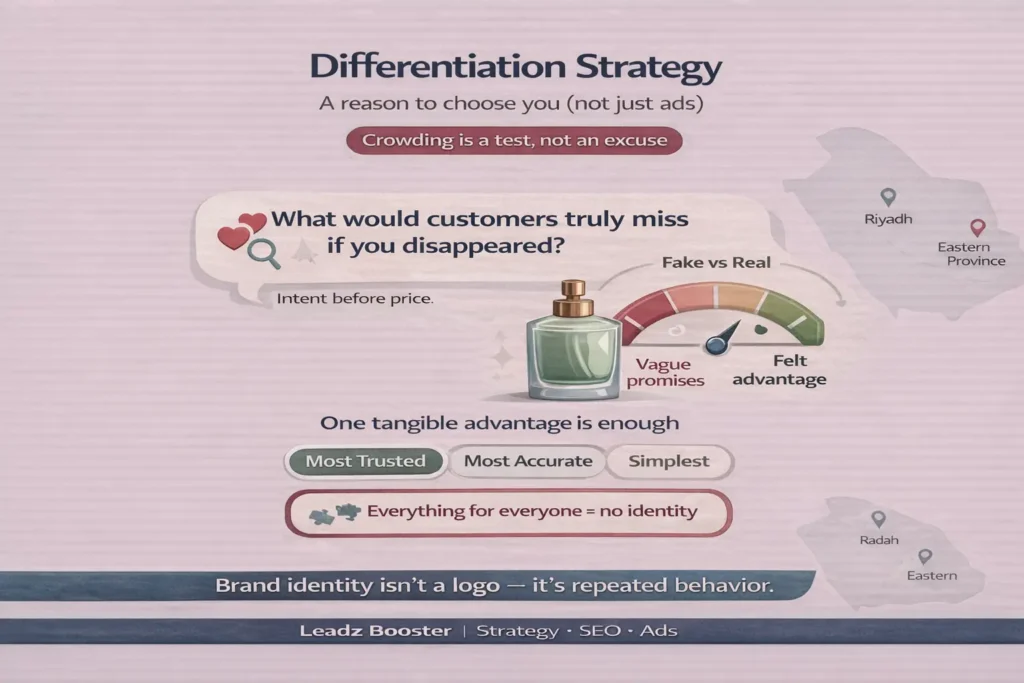
What is the one thing that, if it disappeared from the Saudi market, your customer would truly miss?
If you can’t find an answer, you’re selling “like everyone else.” And the Saudi customer is sharp—he reads intent before price, and he can smell pretense the way a perfumer detects fake musk.
True differentiation does not mean shouting louder. It means saying something your competitor simply cannot copy without being exposed. One tangible advantage is enough—provided it is felt:
- The unboxing experience.
- Speed and clarity of exchanges.
- A guarantee that doesn’t twist around your words.
- An honest product description.
- Or a credible origin story that can actually be verified.
Short sentence: don’t exaggerate.
Then tie your differentiation to a precise mental position: to be “the most trusted”, “the most accurate”, or “the simplest” in a narrow category.
The problem? Many brands want to be everything for everyone—so they end up with no identity at all, like coffee without cardamom.
And in digital marketing, brand identity is not a logo.
It is a repeated behavior… something the customer sees in every click, every message, and every invoice.
The Chain of Reassurance: Differentiation Starts with Shipping and Returns, Not Design
If differentiation is a promise, then fulfilling it is the business. And this is where the Saudi battle really happens—where many don’t look:
the last mile of delivery, the receiving experience, and what happens after the purchase.
I’ve seen campaigns boost sales for a week and destroy reputation for months… because of late shipments or vague return policies. A silent loss. Painful.
That’s why, when I build a differentiation strategy in digital marketing for an online store inside Saudi Arabia, I start with what I call “the chain of reassurance”:
- Clear shipping terms.
- Transparent tracking.
- Payment options that actually match the segment you serve.
- A return/exchange policy written in human language, not in pure legalese.
Then I add a “touch that can’t be bought”:
Customer service that answers as if it knows you, not as if it is reading from a script.
But differentiation doesn’t live on “niceness” alone; it needs a positioning that closes the door on competitors.
Positioning means planting a single sentence in the customer’s mind that comes before any decision:
- “These guys are the fastest.”
- “These people describe products most honestly.”
- “They fix the root of the problem, not just its surface.”
If you don’t choose that sentence yourself, people will choose it for you… And it might be harsh.
A note from experience:
Don’t brag about innovation if the core of your service is shaky.
Innovation on soft ground turns into decoration that falls first. Put differentiation at the core of the experience, then let your marketing polish it—not the other way around.
Your Purple Cow: One Remarkable Feature People Talk About
I was watching a campaign for a Saudi store selling “specialty coffee” and noticed a funny, painful paradox: every ad looked the same, every store claimed uniqueness, then they all wondered why customers treat them like a vegetable market—bargaining, comparing, and switching with no regret.
Here, the differentiation strategy in marketing shows its true face:
Create your purple cow inside the experience, not just on the signboard.
One thing.
Unforgettable.
Three words are enough.
Examples?
- “Taste before you buy” in the form of small samples included with every order.
- Or “honest description only” with a written pledge: If the flavor is not as we described, we refund your money.
Short sentence: a clear promise.
But differentiation is not acrobatics; it’s a deliberate design of whatever makes people talk about you on their own.
When your product or service is easy to retell as a story, the customer becomes a messenger—not just a buyer.
That’s the real difference between a store that burns ad budget daily… and a store that builds a place in the market’s memory.
Try asking your customer after purchase:
“If you told a friend about us, what would you say?”
If they stutter, your positioning is foggy.
lass=”yoast-text-mark” />>If they answer with one sharp sentence, congratulations—you’ve started to differentiate yourself without shouting.
Message–Pricing Consistency: When Numbers Expose Your Promise
Because we’re talking about the Saudi market, digital differentiation is not complete without a message that cuts through doubt.
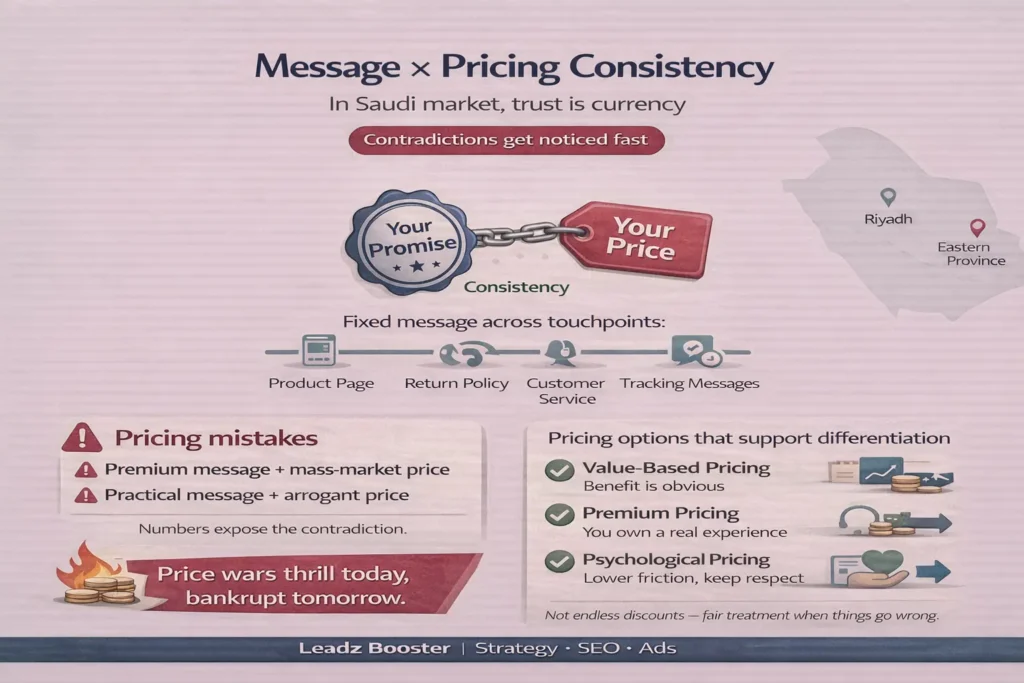
Trust here isn’t a luxury; it’s a currency.
That’s why I see mental positioning beginning with a clear value proposition and a unique ad message—then fixing it across every touchpoint:
- Product page.
- Return policy.
- Customer service responses.
- Even the text in your tracking messages.
One word changes direction: consistency.
But many brands kill themselves in the pricing corner; they want to look premium with a “mass-market” price, or look practical with an arrogant price.
The customer spots the contradiction fast.
If you want differentiation, your price must support the brand image, not expose it:
- Value-based pricing occurs when the benefit is tangible and obvious.
- Premium pricing when you truly own an experience that justifies the number.
- Or smart psychological pricing when you want to lower decision friction without insulting your brand.
Short sentences. Precise.
Beware of price wars; they thrill you today and bankrupt you tomorrow, and they hollow out “differentiation” until it becomes an empty slogan.
Real differentiation in Saudi e-commerce usually stands on three pillars:
- Clear promise.
- Ease of action.
- Generosity after the sale.
And generosity here doesn’t mean endless discounts;
Generosity is treating the customer fairly when something goes wrong.
Trust Wins: A Product Page That Answers Before Being Asked
I remember a campaign for a Saudi store selling men’s grooming products. They thought differentiation meant “a black design and rough phrases.” Then they discovered, too late, that customers don’t buy color…
They buy comfort.
This is where the differentiation strategy in digital marketing is truly tested—in places the store owner rarely looks while obsessed with ads:
- A product page that answers before it’s asked.
- Photos that show the real size, not a Photoshop dream.
- Reviews that are documented, not fake compliments.
Short sentence: trust wins.
In the Saudi market, trust is built through details:
- Payment options that make sense.
- A return policy that doesn’t change shape.
- Delivery times that don’t promise what you can’t deliver.
Then content joins—not as decoration, but as proof:
- A short video explaining how to use the product.
- An honest comparison between two versions.
- Clear guidance that prevents misunderstandings before they turn into one-star reviews.
Differentiation is not complete without a voice that sounds like your audience:
- Modern standard Arabic, when the situation calls for it.
- Practical, direct phrases when the goal is to close hesitation.
I believe the greatest asset a Saudi online brand can have is unshaken clarity:
Who do we serve?
What do we fix?
Why us?
If you can compress your promise into one line, you’ve put your finger on something that can’t be easily taken away.
If you need a long speech, you’re probably selling a weak idea. Weakness always drags prices down in the end, even if you hate to admit it.
A Price That Makes Sense, Not a Price That Shows Off: Raise Meaning Before You Raise Numbers
Now we arrive at a sensitive area many avoid: pricing.
Most online brands that sing about their differentiation strategy in marketing fall into one trap:
They raise the price without raising the meaning.
It’s like wearing a luxurious cloak over a worn-out garment.
Differentiation in Saudi Arabia doesn’t always mean you’re the most expensive. It means your price is understandable because your value is visible.
How?
- Build a clear ladder of options: Good – Better – Best. Three levels are enough.
- Make each level show a difference the customer can see:
- Longer warranty.
- Installation service.
- Gift wrapping.
- Faster delivery.
- Or after-sales support via WhatsApp.
Short sentence: Pay—and get.
The most dangerous killer of differentiation is random discounting: today 30%, tomorrow 50%, then “insane mega offer”.
The market doesn’t clap for long; it quietly asks:
“So what’s the real price?”
That’s why, when I want to build a differentiated brand, I prefer value bundles over discount wars:
- A Ramadan bundle that doesn’t just lower the price, but adds meaning.
- A subscription plan that doesn’t sell once, but builds a habit.
Watch one crucial point:
Don’t raise prices and ignore the post-purchase experience.
If the Saudi customer feels pushed into a higher price without a clear payoff, he will punish you silently… and then tell your story in a family group or friends’ chat.
Here, pricing becomes part of your reputation, not just a number on a screen.
The Journey Matters More Than the Banner: Touchpoints That Shape the Decision
If you asked me: Where is differentiation really tested in Saudi digital marketing?
I’d answer without hesitation:
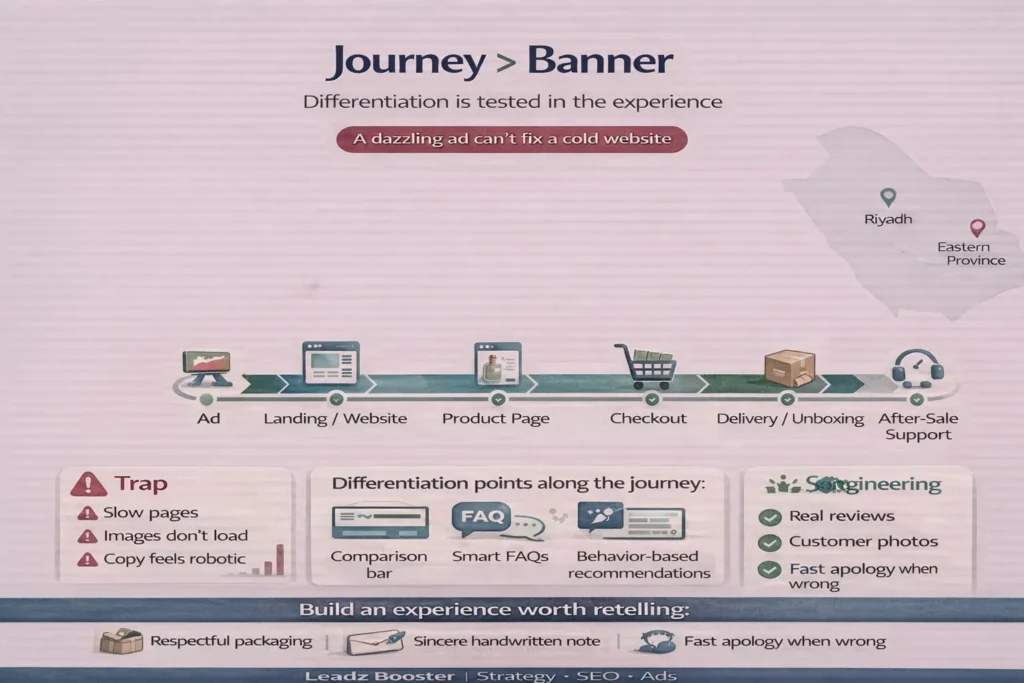
In the journey, not in the banner.
Many brands create a dazzling ad… then throw the customer into a cold website:
slow pages, images that don’t load, and copy that reads like a school newsletter.
That’s a trap.
Here, the differentiation strategy in e-marketing becomes a matter of fine engineering:
- Site speed.
- Clear navigation.
- A product page that makes you feel there’s a human who understands your questions—
not just a store that only cares about your payment.
Short sentence: make it easy.
Then plant your differentiation points along the journey:
- A clear comparison bar between products.
- Smart FAQs that shut down objections before they grow.
- Recommendations based on customer behavior, not just “system mood”.
- A post-purchase message that explains what happens next so the customer doesn’t float in a void.
But the most critical factor in the Saudi market is social reassurance:
- Real reviews.
- Customer photos.
- Proof that the product is not just an idea on a screen.
People here share their experiences fast; family and friends’ groups are sometimes stronger than your ad.
So, build an experience worth retelling:
- Packaging that feels respected.
- A handwritten note that’s genuinely sincere.
- A quick apology when something goes wrong.
The proverb says: “A slip for a slip.”
I’d add:
A slip is forgiven if the customer sees you respect their intelligence.
Ignoring messages, though, is not a slip… It’s a breakdown of the relationship.
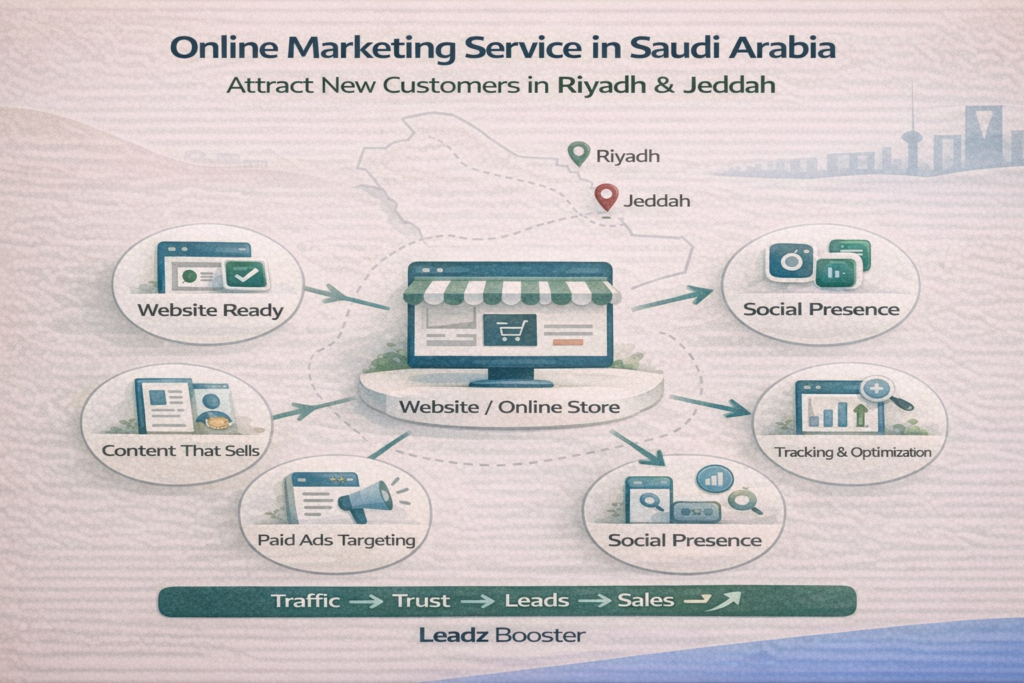
Keep reading and uncover secrets that can change the way you work. Online Marketing Service in Saudi Arabia – How We Help You Attract New Customers in Riyadh and Jeddah
Differentiate With Content, Not Noise: Usefulness That Ends Hesitation
There’s a popular illusion I like to slap—gently:
“We’ll differentiate with content.”
Alright… what content?
If your content is just a rephrasing of what everyone else says,
You’re simply making the fog thicker.
Differentiating with content means offering an angle others don’t dare touch:
- An opinion backed by real experience.
- A how-to guide that reduces mistakes.
- An honest comparison with alternatives.
- Or exposing “common mistakes” in buying this product—and how customers can avoid them.
Short, sharp lines.
In Saudi Arabia, the content that works best is not the most eloquent…
It’s the most useful at the moment of decision.
Here, the differentiation strategy in marketing acts like a scale:
- Pre-purchase content that answers and reassures.
- Post-purchase content that teaches and reinforces the value.
Then you step into “community” carefully:
- Collaborate with influencers who don’t betray their audience.
- Design a real experience for them, not just a script.
- Ask them to mention what they liked and what they didn’t.
Yes.
Honesty here boosts credibility more than pure praise.
But influencer work without structure turns into chaos. So set clear rules:
- Who is their audience?
- What’s the core message?
- How will you measure the collaboration?
And remember:
The influencer is a channel, not an identity.
The brand identity stays with you:
in your language, your experience, and your consistency in keeping promises.
Handing your identity to someone else is like giving a stranger your house key,
then being surprised by the mess.
Keep reading and uncover secrets that can change the way you work. What Are the Types of Marketing Strategies and How Do You Choose the Right One for Your Business?
Run the Promise Daily: Measurement That Doesn’t Flatter, Operations That Aren’t Improvised
The most dangerous moment for differentiation isn’t when you launch the campaign.
It’s right after the first success.
Orders start flowing in.
Shipments expand.
The team flips into “emergency mode”.
That’s when promises start falling like dry leaves. I’ve seen it over and over.
That’s why I set a strict rule for any differentiation strategy in e-marketing for the Saudi market:
Never announce a value you can’t operate every single day.
Short sentence: run it first.
Differentiation is not an idea born in a meeting. It’s a system:
- Clear quality standards.
- Customer service replies written with a brain, not a template.
- Warehouse and fulfillment teams are properly trained.
- Weekly measurement that doesn’t flatter anyone.
Then let measurement serve your differentiation, not distort it:
- Track response time.
- Return/refund rate.
- Post-delivery ratings.
- Complaint rate compared to total orders.
That’s your “truth gauge”.
Yet many brands measure what’s easy (visits, likes) and ignore what’s hard (satisfaction, repeat purchase, referrals).
Here, the road splits between:
- A store that becomes “famous”, and
- A store that actually endures.
And because the Saudi market loves clarity, write your promise boldly on your website:
- What do we promise?
- When?
- How do we fix things when they go wrong?
Don’t leave the customer guessing; guessing breeds suspicion,
And suspicion kills conversions.
As the proverb says: “Doubt ruins affection.”
I’d add:
Selling is a form of affection—if you truly understand it.
Keep reading and uncover secrets that can change the way you work. How to Benefit from Digital Marketing and SEO
Brand Personality: What Competitors Can’t Copy Even If They Copy Everything Else
Let me leave you with one last “key”—not as a conclusion,
but as an annoying beginning to better questions:
Differentiation in Saudi e-commerce doesn’t live on a single idea forever.
The market changes.
People’s expectations rise.
Competitors learn fast.
But there is one thing they struggle to copy: your consistent personality.
To be:
- Honest in your descriptions.
- Fast in correcting mistakes.
- Generous in solutions.
- Sharp in focus.
Four traits. Enough.
When your differentiation strategy in digital marketing is built on this personality,
It turns into an operational reputation, not just décor.
- They might copy your website design.
- And they might copy your offers.
- They might even repeat your exact words.
But they cannot copy:
- How you handle mistakes.
- How quickly you make things right.
- Your ability to say “no” to what doesn’t fit your brand.
That’s exactly what makes the difference in the Kingdom:
The Saudi customer doesn’t just want a pretty story;
They want to feel you actually stand behind your words.
So ask yourself now, far away from campaign dashboards:
- If a shipment is delayed…
- Or the product arrives below expectations…
Will your brand personality show up?
Or will you hide behind a vague policy?
In that one question, differentiation is either born… or dies.
Turn your goals into real achievements with our tailored services – request the service now.
Ready to turn your website into a real client-generating asset?
Book a free consultation with the
Leadz Booster team — we review your current tools and suggest a practical roadmap that fits your budget and growth goals in Saudi Arabia.
Or contact us directly via WhatsApp to start your quick website diagnosis.
FAQ: Real vs Cosmetic Differentiation in Digital Marketing (KSA)
1) What is the difference between real differentiation and “cosmetic differentiation” in digital marketing?
Real differentiation is felt by the customer: clear promise, truthful product description, fast delivery, easy returns, and responsive after-sales support. If experience improves risk, time, or effort, it’s real.
2) How do I choose a differentiation angle that fits the Saudi market without feeling forced or fake?
3) Can I build a differentiation strategy with a small ad budget?
4) What customer-experience elements create differentiation in Saudi online stores?
Shipping: speed, transparent ETAs, live tracking.
Trust: genuine reviews, accurate descriptions, local proof.
After-sales: fast WhatsApp/email responses, fair resolutions.
These beat flashy creatives if they reduce friction and uncertainty.
5) What indicators confirm that my differentiation strategy is actually working?