Email as a Communication Tool: Your Guide to Effective Use
Email as a Communication Tool Marketing Channel
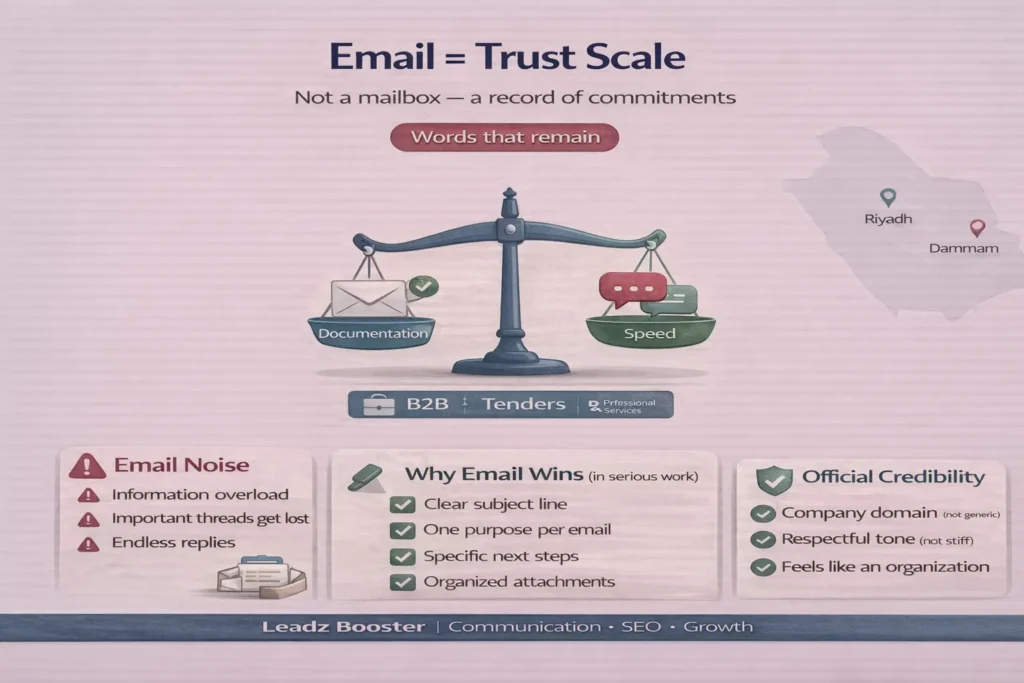
Once, I received an email from a Saudi client at dawn to the company inbox: “If you don’t reply today, I’ll buy from someone else.” He wasn’t threatening as much as he was exposing a simple truth: email is not a mailbox— email as a communication tool is a trust scale placed on the table, and whoever takes it lightly loses before the game even begins. Oddly, many people in the local market treat email as an old tool, then sprint toward instant messages as if they’re a sales spell. A costly mistake. Email doesn’t compete with WhatsApp in speed, but it surpasses it in something heavier: documentation, clarity, room for detail, and the ability for a message to remain a reference after a week or a month. A short sentence: words that remain.
That’s why serious companies in Saudi Arabia—especially in B2B, tenders, and professional services—don’t sign anything and don’t promise anything except through email, because it regulates commitments and prevents the “misunderstanding” that drags disputes behind it. Yet email isn’t always innocent; if you overuse it without rules, it turns into noise that chews up your team’s attention and creates information overload, so important messages get lost between threaded replies. Here, craftsmanship appears: a clear subject line, one purpose, specific steps, organized attachments, and a professional signature that summarizes who you are and how you can be reached.
And I believe the best thing email offers a Saudi business is that it builds official credibility without trying too hard: a company domain instead of generic addresses, respectful language without stiffness, and a message that makes you feel you’re dealing with an organization—not a mood. The Saudi client catches these signals quickly, like a falconer who recognizes the bird from the beat of its wings.
Email as a Marketing Channel: How to Sell Calmly Without Annoying People?
Then comes the side that many underestimate: email as a communication tool—not just a messaging tool. Here, the game changes. A marketing email is not a post you copy and paste into people’s inboxes; it’s a one-way conversation that respects the recipient’s time and knows when to be silent. A short sentence: don’t nag. Experience shows that when email is managed with intelligence, it can deliver a high return for a lower cost than many channels—because you’re speaking to people who already agreed to hear from you in the first place, not to a passing crowd that walks past your ad the way it walks past a roadside billboard.
But the trap here has two jaws: send too much and people hate you, send too little and they forget you. The solution isn’t the “number of emails,” but the intelligence of the email: segmenting lists by interest and behavior, disciplined welcome sequences, a polite reminder for abandoned carts, seasonal offers that choose their timing well in Saudi Arabia (Ramadan, Eid, back-to-school), then post-purchase emails that educate the customer, reduce returns, and increase satisfaction. Once you master this path, email becomes like a salesperson who never sleeps—yet also never annoys, if you set the rules.
Still, email isn’t a magic wand.
It has its flaws: the risk of tone being misunderstood, slow responses when left without follow-up, and the dangers of spam and fraud if you get careless with security. That’s why you need internal discipline: when do we use email, and when do we use a call? Who responds? Within how many hours? How do we archive threads and name files? These details—and I know they sound boring—are what separate a company that communicates professionally from one that merely exchanges messages. And as the proverb goes: “Whoever doesn’t know the falcon will roast it.” Whoever doesn’t know the value of email wastes a tool that can protect their reputation before it protects their sales.
Email Exposes Your Chaos: The Professional Message Protocol in Saudi Arabia
The first thing I do when training a Saudi team on business email is to put a harsh truth in front of them: email doesn’t only reveal your intelligence… it reveals your chaos too. One bad email is enough to lose a deal, or plant doubt that doesn’t disappear easily. Three words: don’t underestimate it. In the Saudi business environment, email needs a simple but strict “protocol”: a subject line that describes the content instead of flirting with it, a brief opening that respects the context, then the core message in clear bullet points, followed by a specific request that leaves no room for interpretation: Do you want approval? A meeting time? A file? A signature? Then come attachments named with common sense: Proposal-Price-Company-Riyadh-2026.pdf, not “final_final2.pdf.” A small difference. Deadly.
And I think the biggest professionalism upgrade is controlling tone: no dryness that stings, and no softness that drops your authority. When writing to a government entity or a large company, write like someone walking on a clean carpet—measured steps. When writing to an individual client, write like someone sitting with them in a respectful majlis—closeness without cheapness.
Then comes the secret many miss:
email is not only text, it’s decision design. If your email is long, make it long for a reason: information, numbers, terms, alternatives. And if it’s short, make it short for a reason: one question, one action, one deadline. Hesitant sentences ruin work.
Then set internal “reply rules”. Who answers what, within how many hours, and how the issue is escalated if the other side stays silent—because email without a follow-up system becomes a polite cemetery for requests. And I always remind teams of a simple principle: email is not a place to settle personal scores; it’s a place to lock in facts. If you’re angry, write the draft, leave it for ten minutes, then return with a cooler eye. In Saudi markets, words are remembered—even if you think they flew away.
The Recipient’s Right Comes First: Segment Lists Instead of Random Blasting
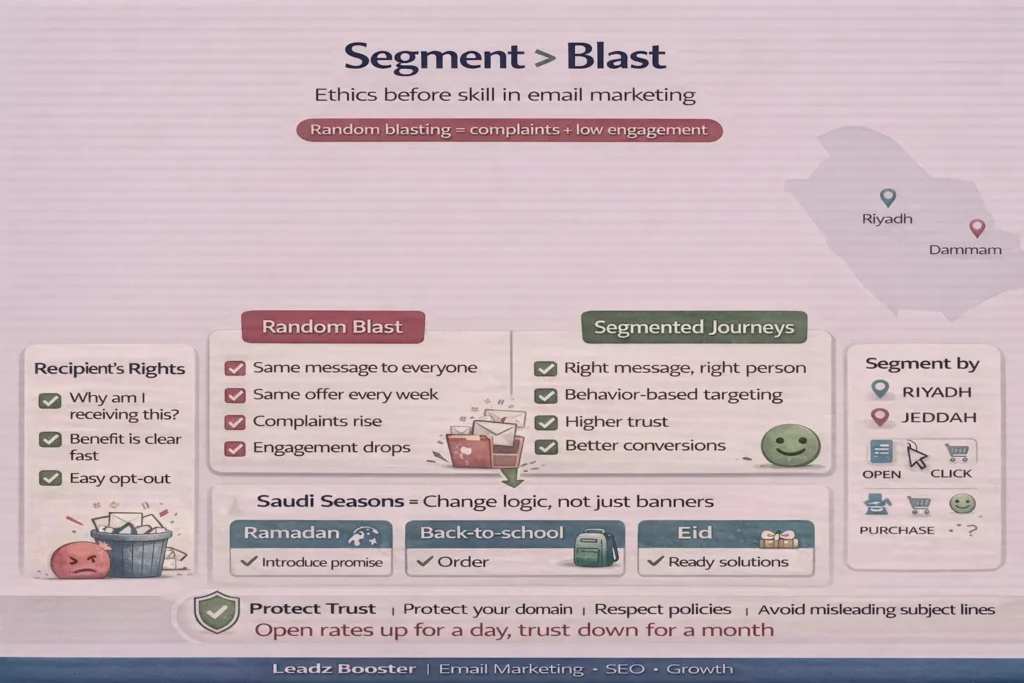
Now we move from “work correspondence” to “marketing email,” and here ethics are tested before skill. Many companies in Saudi Arabia treat email campaigns like an ad dumpster: the same message to everyone, the same offer every week—then an innocent surprise: why are complaints rising and engagement dropping? Because you treated people like numbers. A short sentence: people get annoyed.
If you want email to become a channel that sells without making people hate you, start with what I call the recipient’s right: their right to know why they’re receiving the message, their right to understand the benefit quickly, and their right to leave easily if they’re no longer interested. That alone changes outcomes. Then work on the backbone of the campaign: segmentation. Don’t send a customer who bought a perfume an email about B2B services. Don’t send someone who purchased yesterday the same repeated offer as if you can’t see them.
Segment by city sometimes (Riyadh doesn’t buy like Jeddah in rhythm), and by behavior most of the time (open, click, purchase, hesitation). Then build journeys, not explosions: a welcome email that introduces you and your promise, then an email that proves value with an experience or evidence, then a calculated offer for those who showed intent, then a post-purchase email that teaches, reassures, and requests a review with intelligence.
And when Saudi seasons arrive.
Don’t settle for swapping a banner image and adding a crescent—change the logic. In Ramadan, people search for ease, gifts, and time. In back-to-school. They search for order. In Eid, they want a ready solution that saves them embarrassment. Email becomes an assistant, not an annoying salesperson.
Still, email has thorns: deliverability, spam, and fraud. Protect your domain, regulate sending behavior, respect platform policies, and don’t play the misleading-subject-line game. It may lift open rates for a day, but it breaks trust for a month. And I believe trust is capital you don’t gamble with.
Email Is a Majlis, Not a Trash Can: Write to Be Respected, Not Just Opened
The biggest misunderstanding I’ve seen in Saudi companies is believing that “email” is merely a sending channel, and that success is measured by volume. No. Email is like a majlis: if you enter without manners and without a purpose, you leave with a bad reputation before you leave with a result. A short sentence: respect the place.
That’s why when we design a respectable email campaign, we don’t start with “the message text,” but with the promise: what will the recipient truly gain if they open? Then we write as if we’re paying for every line. Language here isn’t decoration; it’s economics. Write a long sentence when you need to remove confusion, then cut it with a short sentence that places the decision on the table: “This is what’s needed.” Or: “Choose your time.”
Then notice a rule many ignore: email isn’t always read on a desktop. In Saudi Arabia, many people open emails on mobile between meetings and errands. So make the first paragraph a clean hook: one idea, one benefit, one link. Don’t flood the email with multiple buttons—too many exits kill the decision.
After that comes the real weapon:
true personalization. Not the client’s name in the greeting, but signaling their context. Someone who bought a product—send what helps them use it. And someone who visited a pricing page—send a clear comparison or answer a likely objection. Someone who abandoned the cart—don’t scold them. Remind them politely, and offer an exit if price is the issue: “Would you like installments?” or “Do you need a quick consultation to choose the best option?” Believe me, many people don’t abandon a cart out of hate; they abandon it because they hesitated over a small detail. That’s where email has value: it fills the gap.
But email can turn against you if it becomes a chase. Repetition without meaning trains people to ignore you. And as the proverb says: “The more someone knocks, the less they’re respected.” Don’t be the one who knocks every hour. Be the one who knocks when they have something worth hearing.
An Internal System, Not a CC Theater: Who Replies, When, and How Do You Escalate?
Now we enter the layer only those who’ve suffered really see: how do you keep email from becoming an internal burden? Because email isn’t only a relationship with customers—it’s also a relationship between departments inside the company: sales, support, finance, management. If that relationship is unclear, email turns into a long chain of “resend it,” “where’s the file?” and “I didn’t get it.” An administrative trap.
That’s why I prefer giving companies simple rules that resemble “traffic laws”: every email has one topic, every topic has one owner, and every step has a declared deadline. End the email with a line that can’t be misunderstood: “Next step: approve the proposal by Thursday.” Or: “Please provide the commercial registration before 12:00 PM.” A short sentence: a clear deadline.
Then use CC cautiously. Many people think CC is proof of transparency—when it’s sometimes proof of fear. If you copy half the company on every email, you’re building a stage, not a system. Put CC only for those who truly need visibility, not for those you want to “scare” into doing something or to shield yourself from blame.
Then comes a sensitive file in the Saudi market:
Professional email on your own domain. Having an email address under your company name isn’t a luxury—it’s an identity card. But it’s also a responsibility: account protection, strong passwords, enabling two-factor authentication, and training the team against phishing and suspicious links—because one fraudulent email can steal accounts or redirect a payment to the wrong place. Here, email becomes a double-edged weapon, as experience proves through its benefits and risks.
On the marketing side, don’t ignore what decides whether your email is even delivered: your domain reputation, consistent sending patterns, and honest subject lines. Misleading subjects might raise opens temporarily, then throw you into blocklists. And you don’t want to become like a vendor who screams in the market until people throw him out. Write an honest subject line, then deliver content that fulfills the promise. If you do, email becomes a channel that opens doors quietly—without shouting and without crowding.
Length Isn’t the Problem: Relevance Is the Secret Behind a Successful Email
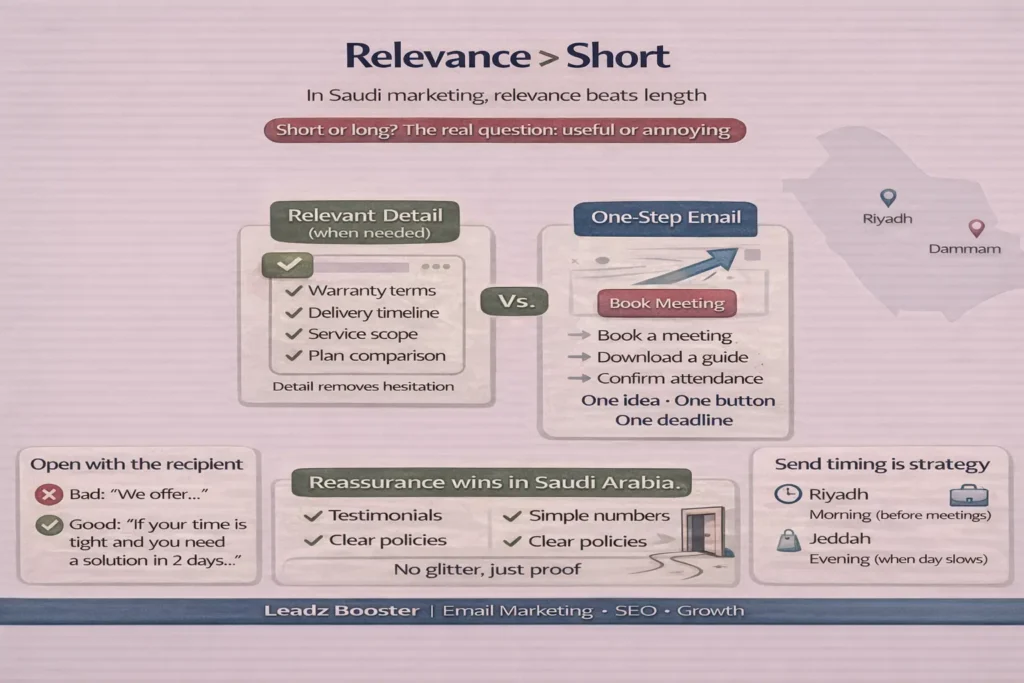
In Saudi marketing, you’ll keep hearing a phrase repeated like a song chorus: “Make the email short.” Fine… short for whom, and when? I believe email isn’t short or long—it’s relevant or annoying. A short sentence: that’s the difference.
An email that resolves complex hesitation might need a detailed explanation: warranty terms, delivery timelines, service scope, or a comparison between plans. But an email whose goal is one step—book a meeting, download a guide, confirm attendance—must be sharp like an arrow: one idea, one button, one deadline.
Then comes a simple trick that feels magical when applied honestly: open the email with a sentence about the recipient, not about you. Don’t say: “We offer…” Say: “If your time is tight and you need a solution within two days…” Then the reader feels the email was written for them, not about you.
After that, give them a path to a decision without cheap pressure: “Pick the best time,” “See an example,” “Ask us which option fits you.” Many campaigns fail because they trap the customer in a corner—and people hate corners. In Saudi Arabia specifically, buying decisions are influenced by reputation and reassurance, not by noise. So let your emails build reassurance: testimonials, simple numbers, clear policies—no glitter.
Also watch something marketers often overlook:
Send timing. Not every audience in Riyadh behaves like Jeddah, and not every industry runs on the same rhythm. Business sectors open emails in the morning before meetings; retail audiences may engage in the evening when the day slows down. Don’t make sending a mindless automation—make it a decision with a reason. And believe me, when a recipient knows you don’t send nonsense, they’ll read you—even if they won’t buy today.
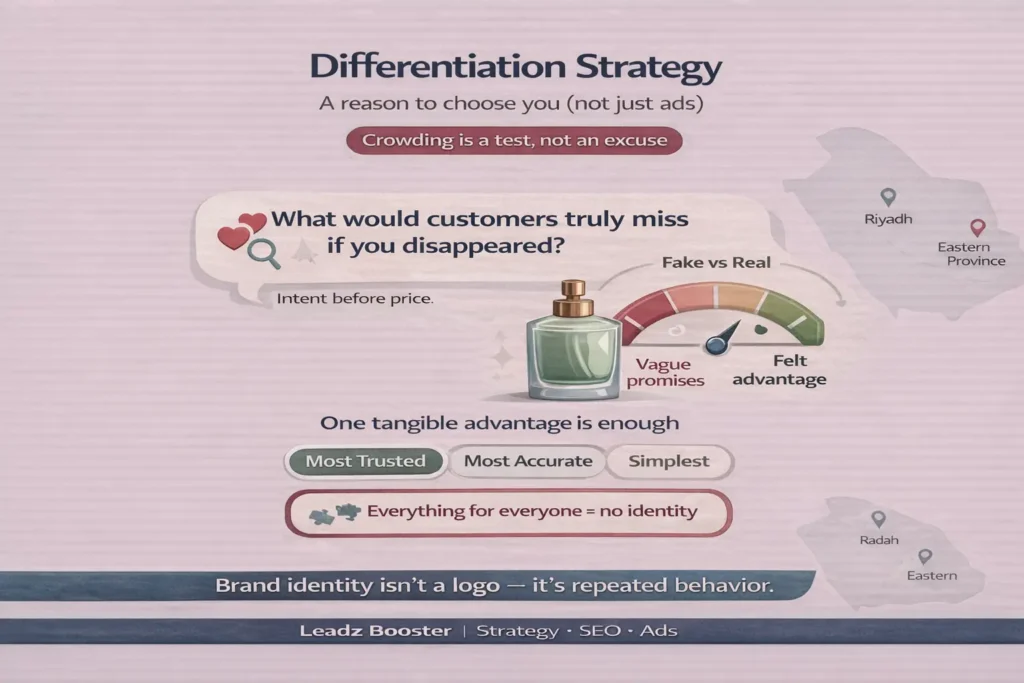
Keep reading and uncover secrets that can change the way you work. Differentiation Strategy in Digital Marketing for the Saudi Market: Practical Steps to Build a Brand That Can’t Be Copied
The Relationship Thread: Email Sequences That Keep the Experience Connected
Since we’re writing about email as a communication tool, let’s challenge a common belief: “Email is only for news and offers.” No. Email can be a powerful relationship-management tool—especially when you design an intentional “message journey” after every interaction. If someone fills out a form. Don’t leave them in silence. If someone downloads a file, don’t behave as if you forgot their name. If someone attends a webinar, don’t drop them the moment the stream ends. Here, email becomes a thread that connects the experience and prevents it from breaking. A short sentence: don’t cut the thread.
Design smart sequences: a welcome email that introduces your promise, an educational email that proves your expertise, an email that asks one question to understand what they need, then an email that offers a suitable next step. This is marketing that doesn’t feel like marketing. But it’s not risk-free: emails can be misread, and the tone can be interpreted as an order or arrogance. So test your language on real humans: a colleague outside the marketing team, or an old customer you trust to be honest. Ask them: “Did it feel respectful?” That one question prevents expensive losses.
Then respect privacy sensitivity in the Saudi market:
Honor opt-in consent, make the unsubscribe option clear, and don’t trade people’s email addresses as if they’re loot. Trust builds slowly and collapses fast. On the professional side, make your email a mirror of discipline: templates for proposals, pricing, and support; organized archiving; and a consistent tone. A company whose style changes from one employee to another feels like it speaks with multiple tongues—this confuses customers. Consistency creates the sense that there’s a coherent institution behind the messages. When email becomes “one voice,” your chances expand in the market without noise—because people lean toward those who understand them and speak clearly.
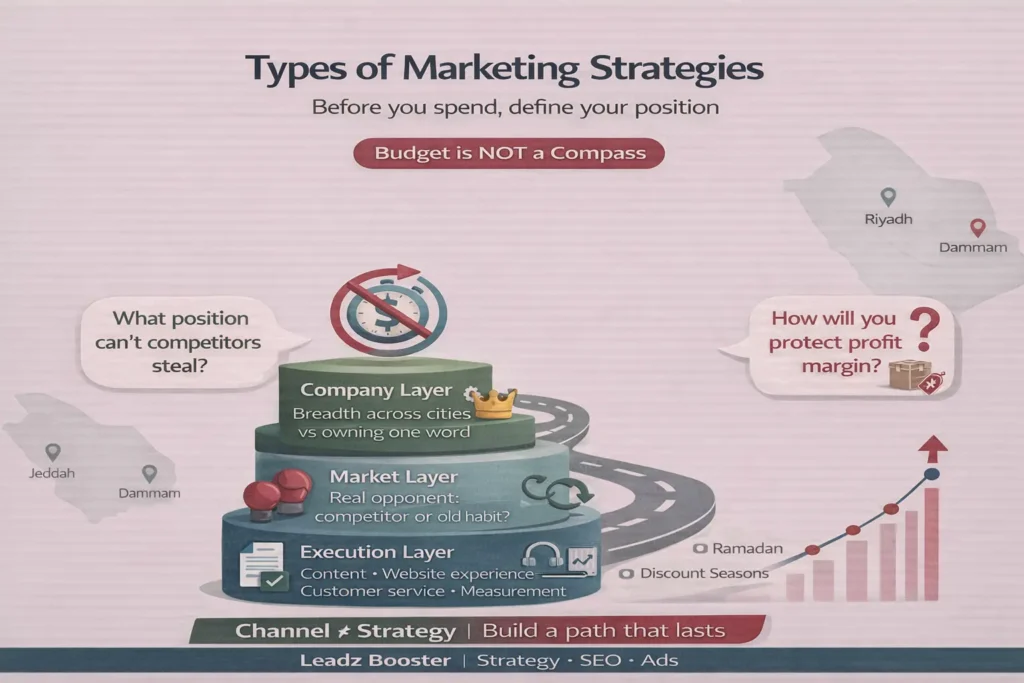
Keep reading and uncover secrets that can change the way you work. What Are the Types of Marketing Strategies and How Do You Choose the Right One for Your Business?
The Three Layers of Email: Service, Educational, and Commercial—Balanced
Sometimes I ask a Saudi company team, “How many emails did you send this week?” They answer proudly: “Eight campaigns!” Then I ask the heavier question: “And how many decisions did you make easier for the customer?” They fall silent. Because email isn’t a race of volume—it’s a race of meaning. A short sentence: meaning wins.
If you want email to be communication rather than noise, build three clear layers of messages, like a ruler: a service layer that explains, confirms, and follows up (order confirmation, invoice, shipping, support).
An educational layer that matures understanding and reduces mistakes (how-to guides, tips, comparisons, answers). A commercial layer that offers an offer when intent exists (limited discount, value bundle, upgrade). Then watch the ratio: if 80% of your emails are commercial, you’re begging for sales. But if your educational and service emails are strong, sales will come as a natural result—not a chase.
The smarter move isn’t only dividing layers—it’s continuity. Write with the same mindset after the customer buys as before they buy. Many companies flirt before payment, then turn into a cold clerk after payment. That psychological rupture kills loyalty. Give every message a “golden sentence” that respects the recipient: “If this message isn’t relevant, tell us what you prefer.” That single admission reduces annoyance and gives you honest data. And believe me: the one who opens the door to dialogue wins—even if they don’t sell today.
Keep reading and uncover secrets that can change the way you work. How to Benefit from Digital Marketing and SEO
Your Company’s Voice on the Screen: Does Your Email Sound Like You—or Like a Borrowed Template?
Let me leave you with an uncomfortable question: does your email sound like your company—or like a borrowed template? Because in Saudi Arabia, people treat email as if they’re hearing your company’s “voice” from behind the screen. If the voice is shaky, contradictory, or arrogant, you’ll lose—even if your services are excellent. But if it’s clear, honest, and consistent, you’ll get a second and third chance—even if you make a mistake once.
Email has a strange power: it locks in impressions and leaves a trace that time doesn’t erase easily, because it remains saved and can be revisited. A short sentence: a lasting trace.
So set a simple charter before every send.
Does this email respect the reader’s time?
Does it deliver real value?
Do it ask for one clear next step?
Does its tone reflect our company culture?
Could a competitor read it and say: “This company knows what it’s saying”?
If the answer is yes, send it. If not, silence is better. The most beautiful thing about email is that it teaches discipline: it doesn’t allow you to “chat” without consequences, and it doesn’t let you escape documenting a decision. From that angle, email becomes a communication tool with others—and an internal training tool too. It teaches teams how to write, how to decide, how to respect deadlines, and how to separate talk from commitment.
So ask yourself tonight: if email disappeared from your company for a week, would your operations collapse? If the answer is yes, you depend on it without managing it well. If the answer is no, maybe you’re leaving on the table a tool that can make your communication more rational… and far less noisy.
Turn your goals into real achievements with our tailored services – request the service now.
Ready to turn your website into a real client-generating asset?
Book a free consultation with the
Leadz Booster team — we review your current tools and suggest a practical roadmap that fits your budget and growth goals in Saudi Arabia.
Or contact us directly via WhatsApp to start your quick website diagnosis.
FAQ: Using Email as a Communication Tool Effectively in the Saudi Workplace
1) When should I use email instead of WhatsApp or a phone call in the Saudi workplace?
2) How do I write a “professional” email without sounding stiff or cold?
3) What are the most common mistakes that make email damage reputation instead of building it?
4) How can I make email an effective marketing channel without turning into an annoyance?
5) How do I protect company email from fraud and phishing—especially around invoices and bank transfers?