What Are the Types of Marketing Strategies and How Do You Choose the Right One for Your Business?
Types of Marketing Strategies: Where Do You Start Before Spend?
An owner of an online store in Riyadh once walked into my office holding a printed performance report from his ad platform and said, with unshakable confidence:
“Our strategy is clear: we’ll increase the budget.”
I smiled—not out of mockery, but because I’ve seen this scene hundreds of times.
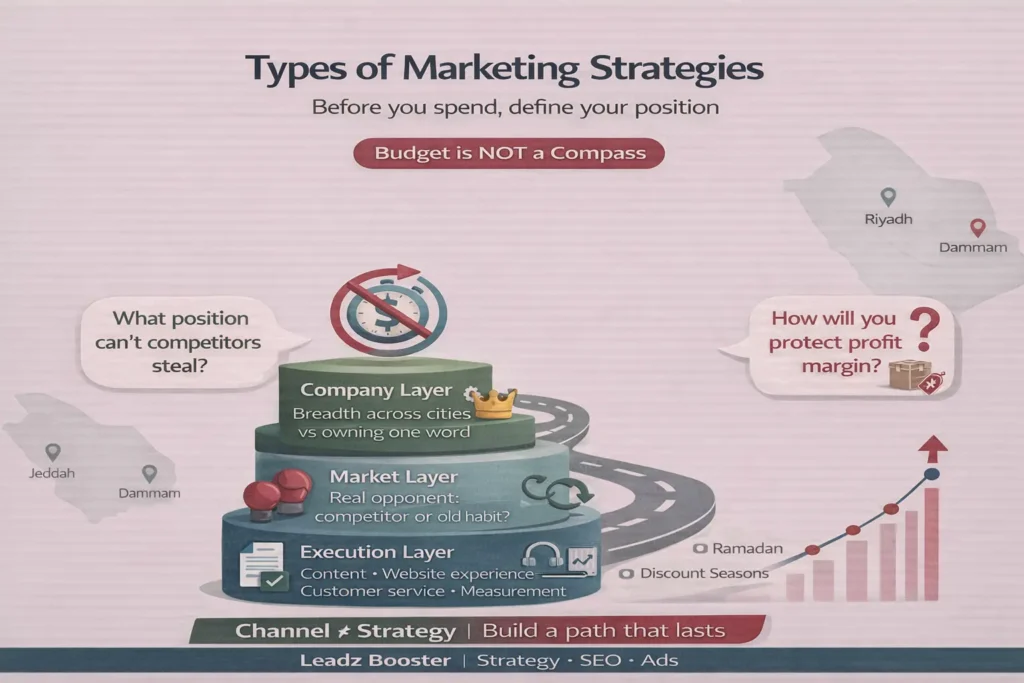
Here’s a short sentence that matters: budget is not a compass.
Anyone who confuses spending with strategy is like someone who buys a shiny sword and forgets to learn how to fight. In my view, the types of marketing strategies start from a question that makes you uncomfortable before it brings you comfort:
What is your position in the market that your competitor simply cannot steal?
Then comes a second question that pinches your profit margin:
How will you protect that margin when shipping costs rise, and discount wars intensify?
There is no single answer here, but layers.
- A first layer belongs to the company itself:
Do you want breadth across cities in the Kingdom of Saudi Arabia, or do you want a specialized brand that owns a single “word” in people’s minds? - Then a layer that belongs to the market you’re fighting in:
Who is your real opponent—
another store that looks like yours,
Or an old consumption habit that refuses to die? - Then a layer for day-to-day execution:
content, website experience, customer service, and the way you measure results.
A few decisive words: the channel is not the strategy.
When you align these layers properly, you stop chasing noise and start building a path that can withstand Ramadan, discount seasons, and the mood swings of the market.
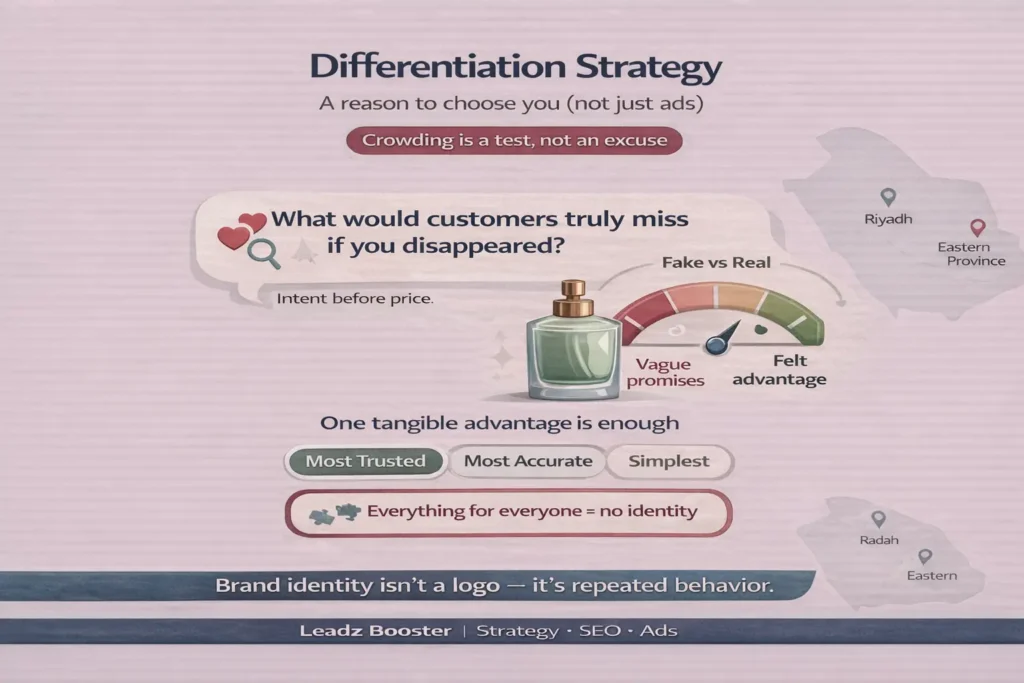
Your Competitive Weapon First: Cost, Differentiation, or Focus?
If I had to summarize the entry point that separates a solid strategy from a colorful gamble, I’d say: choose your competitive weapon first, then distribute your tools.
This is where competitive strategies show their sharp face: you either compete on cost, or on differentiation, or you tighten your scope and win within a specific niche.
Three main paths—but they branch into four routes when you add the factor of scope into the equation:
- Cost leadership
- Broad differentiation
- Cost focus within a specific segment
- Differentiation focus within a specific segment
And the difference between them is not some academic riddle; it’s a decision that changes everything:
- how you design your offer
- your pricing policy
- your messaging style
- even the shape of your after-sales service
In my experience, the biggest trap that swallows many Saudi businesses is the owner’s desire to combine opposites:
“Cheapest price… and most premium experience… and fastest delivery… and everything right now.”
The market has a name for this: being lost.
So ask yourself with the cold blood of an old merchant:
- Are your customers chasing the deal because their wallets are sensitive?
- Or are they chasing peace of mind because their time is more valuable than the price difference?
If it’s the first, then operations, efficiency, and your supply chain are the heart of your strategy.
If it’s the second, then story, packaging, guarantee, and clarity of promise are the heart of it.
After that come the different execution styles: paid media, relationships, content marketing, partnerships, and more… but they all remain servants, not masters.
Don’t let the tools drag you around by the nose.
Goal-Driven Strategies: Fast Sales or a Brand Built Slowly?
Sometimes, your company doesn’t need a “marketing strategy” as much as it needs an honest admission:
You don’t really know what you want yet.
Harsh? Yes.
But it can save you from expensive wheel-spinning.
When we talk about the types of marketing strategies from a goal perspective, you’ll find them like a network of roads across the Kingdom:
- a fast highway for instant sales
- a longer road for building trust
- and narrow side streets for customer retention
The strategy that chases “buy now” demand feeds on:
- clear offers
- landing pages that don’t stutter
- and messages that address objections without embarrassment
Short. Direct.
Whereas a brand-building strategy works like a coffee maker in an old neighborhood; it knows the customer comes back because the taste became a habit, not because the discount was tempting.
Here you bring in:
- content
- visual and verbal identity
- tone of voice
- and consistency over time
But people often confuse “content” with “chatter.”
Content that doesn’t change a decision or remove confusion is just elegant noise.
Then comes the retention strategy:
- after-sales service
- using WhatsApp as a care channel, not just a sales megaphone
- and return/exchange policies that understand how the Saudi consumer thinks when buying, while still hesitant
The common mistake? Managing these types as if they were separate islands:
- aggressive ads,
- a brand that is warm and gentle,
- and support that stumbles…
So the customer feels as if they’re dealing with three different companies under one logo.
The Decision Ladder: How Do You Tie Strategy to Execution Without Chaos?
Now we arrive at the question many people run away from: how do you actually choose?
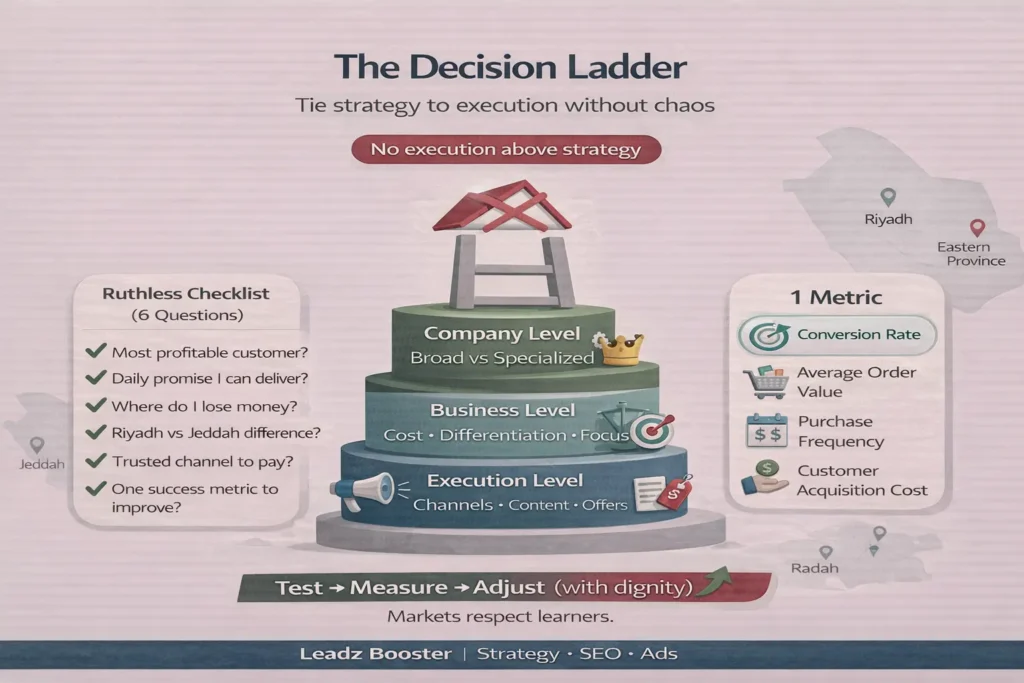
I prefer to start with a ruthless checklist, not a spur-of-the-moment “inspiration.”
Write down these six questions as if you were drafting a contract with yourself:
- Who is my most profitable customer in reality, not in my imagination?
- What “promise” can I deliver every single day without breaking my back?
- Where am I silently losing money: acquiring the customer or in after-sales service?
- What truly differentiates me in Riyadh versus Jeddah or the Eastern Province—product, experience, or delivery?
- Which channel does my audience trust most when they pay—store, app, marketplace, or in-person visit?
- And finally: which one metric, if it improved, would make me comfortable calling my strategy a success—conversion rate, average order value, purchase frequency, or customer acquisition cost?
Few words. Clear numbers.
Once you’ve answered, place the types of marketing strategies on a ladder of levels:
- Company-level decision (broad or specialized?)
- Business-level decision (cost, differentiation, or focus?)
- Execution-level decision (channels, content, offers)
Do not let execution jump above the higher-level decision.
That’s like building a roof before pouring the foundation.
The beautiful thing about choosing is that it is not an eternal oath: you test, you measure, then you change course with dignity.
The market respects those who learn.
And laughs at those who repeat the same mistake and call it “sticking to the plan.”
Smart Local Positioning: What Does Differentiation Really Mean in Saudi Arabia?
Let’s take a familiar Saudi example:
A restaurant in Al-Khobar opens a branch in Riyadh, then complains two months later that “the ads didn’t work.”
My question: did you change your strategy, or did you merely change your address?
The types of marketing strategies are not stickers you slap on your storefront; they are decisions that show up in small details that either stir appetite—or kill it.
This is where positioning becomes the ground you stand on:
- Are you a restaurant of “high value at a fair price”?
- Or a “premium experience”?
- Or a “non-negotiable specialization”—like a very specific burger style, or a coffee profile no one else offers?
If you’re chasing cost leadership, your war starts in the kitchen before Instagram:
- standardizing recipes
- reducing waste
- negotiating with suppliers
…then crafting a marketing message that announces this value without embarrassment.
If you’re chasing differentiation, your battle is about feeling:
- lighting
- story
- service
- plating
…then a language that convinces the customer that the difference isn’t just the “taste”, but the entire experience.
Short sentence: Differentiation is expensive.
But it buys you the right to charge a higher price without apologizing.
As for focus, it is choosing a specific slice of the market:
- office workers at lunchtime
- families in the evening
- strict–diet lovers
Whoever tries to please everyone… gets lost.
And as the proverb implies: “The one who has a strong back doesn’t get hit in the belly.”
Your “back” here is your specialization.
Counting Consequences: The Hidden Cost of Every Strategic Choice
After positioning comes what I call “consequence accounting.”
Every strategy has a hidden bill:
- A cost strategy can drag you into a discount war that fattens your competitors and starves your brand—unless you back it with ruthless operational efficiency.
- A differentiation strategy can tempt you into empty decoration: a new logo, fancy photography, but a cold customer experience… and the structure collapses from within.
- A focus strategy can cage your growth if your narrow segment becomes a prison instead of a conscious choice.
That’s why choosing between different types of marketing strategies requires real-world testing through three lenses:
- Market lens – Are customers actually willing to pay for this promise?
- Capability lens – Can you repeat the same level of quality without collapsing?
- Profit lens – Does the margin truly allow growth?
Then apply a simple rule: ask before you shout.
Before a big campaign, talk to:
- ten current customers
- six customers who left you
- and three people who never bought at all
You will hear what your dashboards never tell you.
Your data tells you what happened.
People tell you why it happened.
Big difference.
After that, put your hypotheses on the table:
- If you lower your price by 10%, will volume truly compensate?
Or will you just attract a herd of “offer hunters” who leave you for the next discount? - If you raise value by adding a warranty or installation service, will your average basket rise?
Or will complaints multiply?
These are not poetic questions.
They are profit–and–loss switches.
Paid, Owned, Earned: A Balance That Doesn’t Bankrupt You or Slow You Down
Let’s open a topic that makes many business owners uncomfortable:
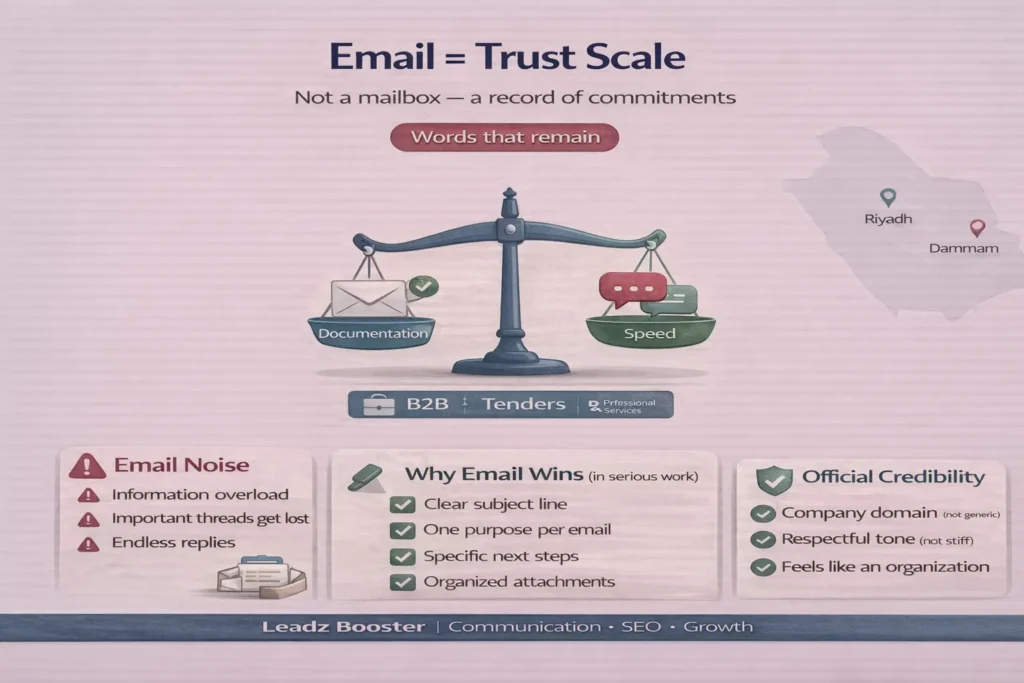
Your “digital marketing strategy” is not a stand-alone strategy.
It’s a playing field where your choices show up.
I’ve seen companies in Saudi Arabia pile everything on Snapchat or TikTok, then collapse the moment the platform tweaks its algorithm or the cost per click spikes.
Here the classic split becomes very useful:
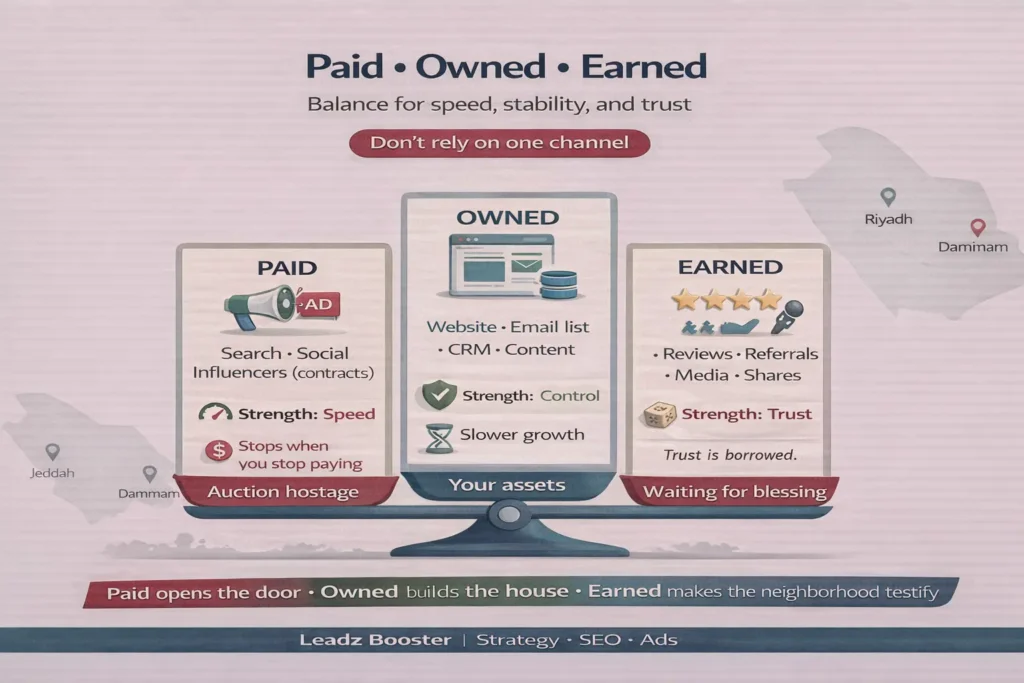
Paid, Owned, Earned.
- Paid: all forms of advertising—search, social, influencers under clear contracts.
- Strength: speed.
- Weakness: no loyalty; once you stop paying, it stops working.
- Owned: what you control end-to-end—your website, email list, CRM, your own content that doesn’t need permission to reach people.
- Earned: what others gift you—reviews, recommendations, media coverage, people sharing your story for free.
Short line: trust is borrowed.
And you don’t buy it easily.
When you choose between types of marketing strategies, don’t let your balance tilt fully toward a single road:
- If you over-invest in paid, you become a hostage to the auction.
- If you rely only on owned, your growth will be painfully slow.
- If you hang all your hopes on earned, you’re waiting for “blessing” instead of planning.
In my view, the smart balance starts like this:
Paid to open the door, owned to build the house, earned so the neighborhood testifies you deserve it.
Keep reading and uncover secrets that can change the way you work. What Is the Best Digital Marketing Method for Your Business? Discover the Solution We Offer
The Realism Triangle: Time, Money, and Skill Decide Your Path
Now to the trap of “ready-made plans.”
I get asked all the time: “What’s the best strategy?”
My answer:
The best strategy is the one your personality and resources can actually carry.
Yes—strategies have temperament.
A small store in Al-Qassim with no content team and no agile customer service that jumps straight into a “luxury brand” strategy is only creating a problem for itself:
- It will over-promise
- Then pay the price in bad reviews
A B2B company in Riyadh selling complex services that copy retail tactics of daily discounts will attract the wrong audience—people who don’t understand its value or pricing.
So I recommend a very practical test I call “the Realism Triangle”:
Time – Money – Skill
Choose a type of marketing strategy that matches at least two sides of your triangle:
- If you have money and time, but weak skills:
Invest in a strong agency or proper hiring; don’t pretend you can “figure it all out” alone. - If you have skill and time, but little money:
Go heavy on valuable content, SEO, and organic channels, and grow slowly but sanely. - If you have money and skill, but limited time:
Run focused campaigns with sharp offers and well-designed landing pages.
And the final decision is not complete without one core metric you watch daily:
- If your goal is customer acquisition, CAC (customer acquisition cost) is king.
- If your goal is revenue growth, average order value and purchase frequency are the judges.
Don’t open ten dashboards and pretend you are “measuring.”
Too many metrics numb the mind.
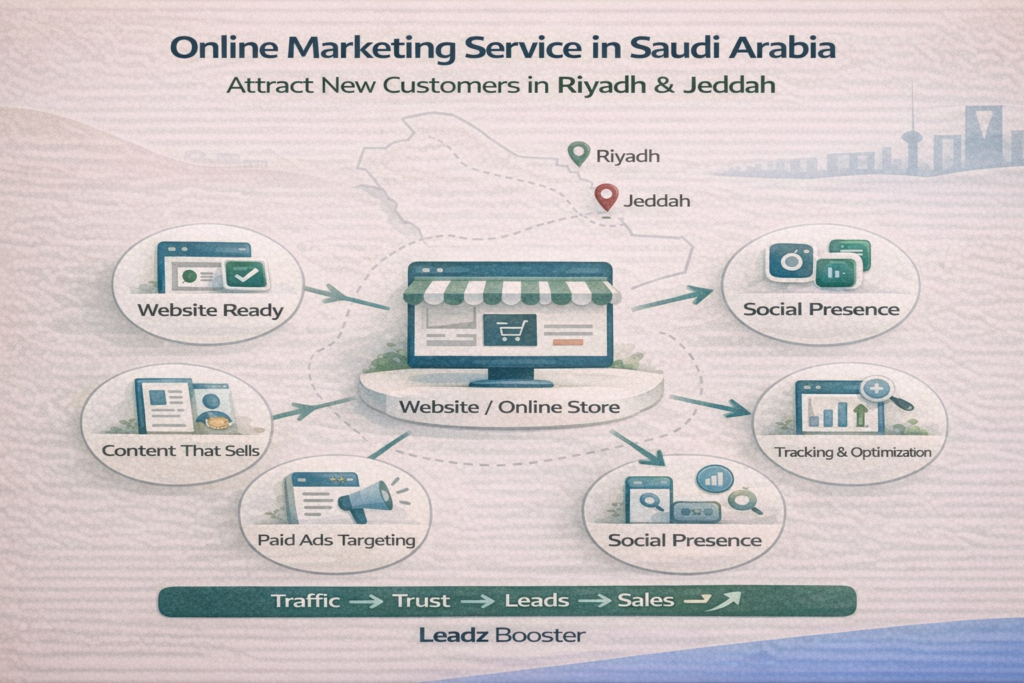
Keep reading and uncover secrets that can change the way you work. Online Marketing Service in Saudi Arabia – How We Help You Attract New Customers in Riyadh and Jeddah
A 5-Step Selection Map: Clear Decisions Instead of Decorative Plans
If you want a quick test that exposes your choice, watch your team’s behavior, not your slogans.
The right strategy changes the way people work every day:
- What do we say “no” to?
- What do we stop doing—even if it’s fun?
- What do we insist on repeating?
This is where the types of marketing strategies appear as small but tough daily decisions:
- saying no to a misfit client even when you need cash
- refusing random discounts even when the short-term numbers tempt you
- keeping your delivery promise even when seasons are crushing you
Short line: A promise is a debt.
Then put in front of you a 5-step selection map that doesn’t need fancy offices or shiny slides:
- Define your local market in Saudi Arabia precisely: city, segment, and purchase context.
- Write a single, two-line value proposition; if you need a full paragraph, you haven’t really decided.
- Choose your competitive logic: cost, differentiation, or focus.
- Design your channel mix across paid/owned/earned with a minimum level of balance.
- Set a clear time test: 4 weeks is enough to see if the needles are moving or not.
Then separate between “improving” and “changing”:
- If people visit but don’t buy, improve the page and the message.
- If they buy once and never return, improve the product and service.
Don’t treat a headache by pulling the tooth.
Keep reading and uncover secrets that can change the way you work. How to Benefit from Digital Marketing and SEO
Do You Want to Be Seen or to Be Understood? A Question That Exposes Your Strategy
I’ll leave you with a question that annoys me every time I see a flashy campaign in Saudi Arabia that shines for a week, then disappears:
Do you want to be seen… or do you want to be understood?
There is a huge distance between the two.
Many businesses pick a strategy that makes them “famous” but not “profitable.”
Some pick a strategy that keeps them “quiet” but builds a depth in the market that only those who read beneath the surface can see.
I believe that the different types of marketing strategies are not a ladder you climb once—it’s a skin that sheds as you mature:
- You might start with a cost play just to enter the market
- Then move toward differentiation once you truly know your customer
- Then shift into focus when you discover where you can earn without bleeding
But moving between these stages needs courage:
- to admit that what worked in Jeddah may not work in Riyadh
- What fits the launch phase may not fit the scale-up phase
- And that “trend” is not destiny
As the proverb says: “Whoever constantly watches people dies of worry.”
I’ll add: whoever constantly imitates them dies of exhaustion.
So ask yourself tonight, without noise:
What is the one idea that, if your customer heard it, they’d immediately say: “That’s you”?
If you find it, you’ll know where to start tomorrow.
If you don’t, the answer might be simpler than you think:
You need to listen more… and talk less.
Turn your goals into real achievements with our tailored services – request the service now.
Ready to turn your website into a real client-generating asset?
Book a free consultation with the
Leadz Booster team — we review your current tools and suggest a practical roadmap that fits your budget and growth goals in Saudi Arabia.
Or contact us directly via WhatsApp to start your quick website diagnosis.
FAQs: Marketing Strategy vs Marketing Plan (Saudi Market)
1) What’s the difference between a marketing strategy and a marketing plan?
The plan turns that direction into timelines, channels, budgets, tasks, and KPIs.
2) What are the most common types of marketing strategies that fit the Saudi market?
3) How do I know if I need a cost strategy or a differentiation strategy?
If customers pay for trust, quality, experience, and guarantees—and you can justify a higher price—differentiation is better.
4) Does social media marketing count as a full strategy on its own?
5) What’s the single most important metric to track to know if my strategy is working?